"If you think adventure is dangerous, try routine; it's lethal." - Paul Coelho

Thursday, May 8, 2014

Bonafacio

As promised, some pictures of Trinite and Bonafacio.  But first, a picture or two of the interior of Corsica.


And of a beach.


What could be lovelier?  This is a distant view of the little city clinging to the hillside that chokes and channels all the traffic through a single street.


But enough.  Trinite.  The entrance to the campground with the cross on the rock in the background.


And a closeup, if you can call it that, of the rock with the cross on it.


My bungalow, generally pronounced "boongalow".


Some of the grounds.


Bonafacio.


The shot above gives you an idea of how the citadel hangs over the Med below.  And then there is this fascinating profile of rock.  It bears a striking similarity to the Corse profile that is the symbol of Corsica.


Here is the house where Napoleon lived when he was a Lt. Col.


The house was on this street, a narrow canyon.


At the top of the town is this monument.  I have no idea for whom or what.  The monument sits right outside the post office of which I wrote earlier.


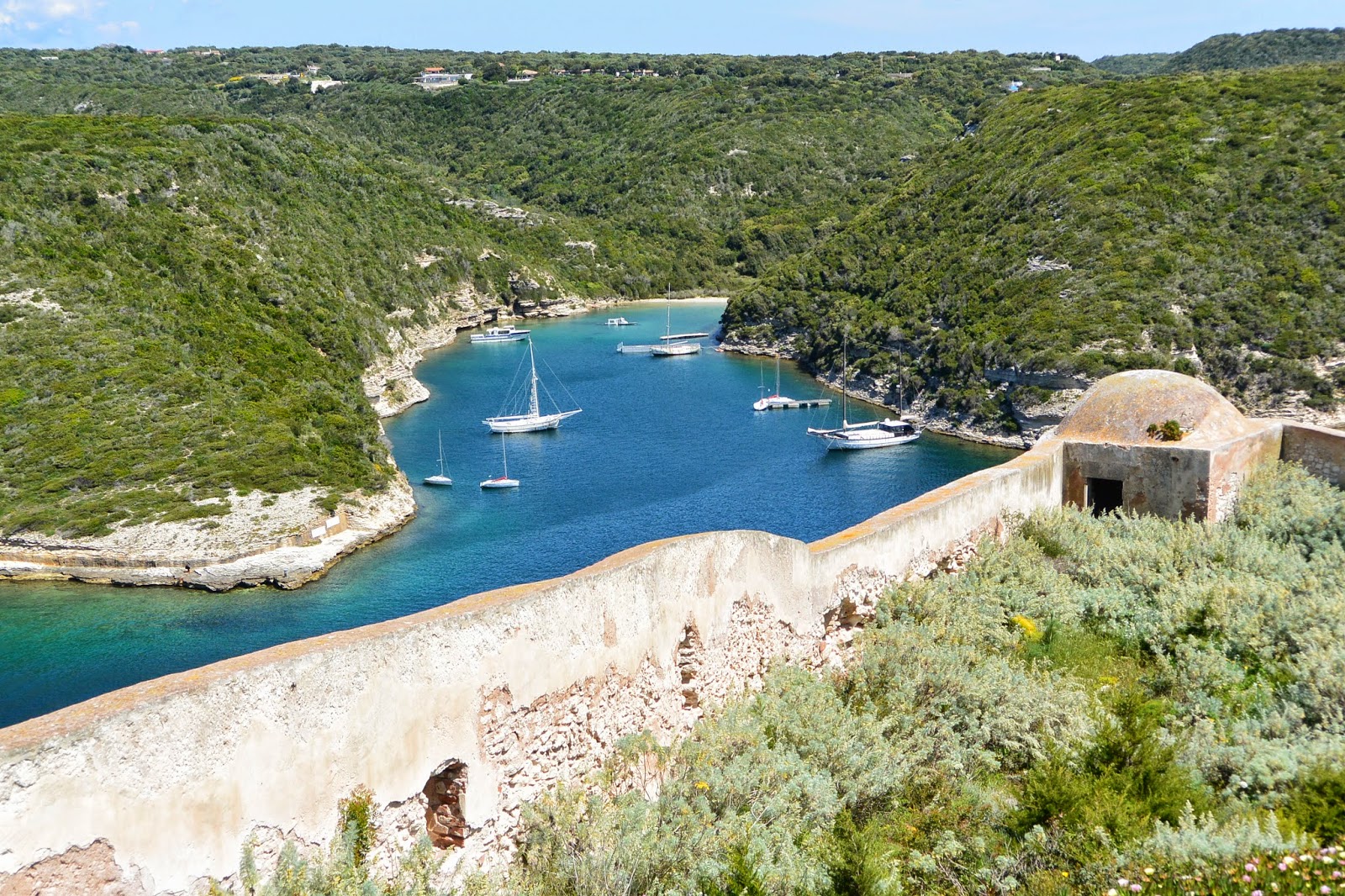
In addition to the marina in town, this little bay is right outside the harbor.


The Eglise St. Dominque.


A plant growing from the rck wall below a window in a part of the old citadel not yet restored.


A door leading into the old armory


Finally, this is a photo of a stairwell leading into a house in the old city.  The houses are literally jammed together.  The dark area above the stairs you can clearly see, are blue wooden stairs that climbed up as far as I could see into the gloom.  The door at the bottom provides entry to the ground floor.  I suspect you got to know your neighbors well.


Verdun

Verdun, the name of a local village, is now used as shorthand to describe a battle that lasted months and stretched over a large area of the Meuse-Argonne.  Regardless, the offensive here was the final great push of the First World War, and led to the Armistice after the Allied Forces pushed the Germans back beyond the Meuse River.  It is an area of forests (one now called the Foret Morte Homme, the forest of dead men) and hills.  I wanted to see this area, just south and west of Luxembourg.  It is sobering.

The remains of the forts, the pill-boxes, and God help us, the trenches where men lived or died through artillery barrages, machine gun fire, and bayonet attacks, remain.  AS do the memorials and the graves.

The French ossuary and cemetery is the largest memorial.  The light within is amber from the glass inset in the southern walls.  It is a beautiful and quiet place.  The cemetery stretches out in front of the memorial, down the hill and towards the town of Verdun.  The memorial is easily found on Google Earth.


The American Memorial sits on a hill, near the top, in front of the ruins of the church that served the community, the abbey and the seminary.


This photograph was taken from the site of the former main street of the small town below the church.  Before the war, it was lined with tall houses, the offices of the local Gendarme,  and the city's administrative offices.  All of the town was destroyed in the fighting.


The structure with the horizontal slit near the top is a German bunker.  It is typical in construction of the others that remain in the area.  It is made with rubble from the destroyed church, cement, and railroad rails in the roofing.  This is the view from the forward bunkers of the hill county to the west.


The countryside is so peaceful now.  But brave men and women fought over it in the screaming hell that was and is war.  As I walked among these positions, and earlier as I walked in the Trench of Bayonets, I was awash with sorrow for the young lives that ended here.

The American Cemetery is near the village of Cunel.  This is the approach to the cemetery from Cunel:


The road above leads through the grounds.  There is an oval drive that surrounds a center park and fountain.  The cemetery itself is to the left as you look through the park.


The fountain in the center points up the hill through the graves on either side to the chapel at the far end and up the gentle slope.  The grounds are very well kept by a French crew hired by the U.S. Government, as these memorials are maintained by the U.S. through agreements with the French government.  I spoke with the Cemetery's manager, and he was very respectful of the responsibility with which he has been entrusted.


As you walk along the graves, and read the markers, it is clear that no one was favored to live in this battle.  There are private soldiers, their sergeants, the lieutenants, the bakers, the buglers, the messmen, the nurses, the Texans, the New Yorkers, the Montanans, the Italians, the Irish, all there.  War doesn't discriminate at all.

The chapel was quiet, and as calm as you would expect.


Behind the chapel, I took a photograph of the hills amongst which these Americans now rest.  It is, as I wrote before, peaceful now, and very beautiful on the edge of The Foret de Morte Homme.


Wednesday, May 7, 2014

Trinite Campground

There is a cross on a large hill of rocks above the campground. Actually, it is related to the Hermitage of Trinite, which I tried to find but couldn't. I spent most of the morning at camp, then road into Bonifacio. 

I parked at the base of the marina, and walked both sides. Then I climbed the hill to Roy d'Artagna's citadel. It was a stiff climb on gentle steps. I think it was the heat that made it seem so steep. The views of the city, coast, headlands and harbor are beautiful. I will post pictures tomorrow. 

There are a number of churches in the high city. The church of St. Dominique, of which I did not get pictures, I found particularly striking inside. It was very simple, and the floor was of hewn stone blocks, maybe ten inches square, set a long time ago and now uneven and worn. The walls and ceiling were largely unadorned, with very little iconography and only one painting. Once again I was reminded of how much love these people have for God, to cut each of these stones by hand, then carry each of them to the top of this hill, and place them there. 

I spent 3-4 hours walking around, looking at the house where Bonaparte lived when he was garrisoned there as a young officer, standing in line at the post office to buy stamps (postal workers work at the same pace in Italy as they do in the USA), and having lunch. 


Then coffee. Note the pyramid of chocolate. 


I bought some tomatoes, a sausage, and a baguette for dinner, and rode back yo the campground. On the way, I tried to find another old church, but it was well hidden, and I was not successful. 
  

Tuesday, May 6, 2014

Ajaccio to Bonafacio

After a cold water shave, I got on the road, N196, to Bonafacio. Laurent and Karen passed me on the way to their hike. N196 is a good road, and it has it's twisty parts too. Sometimes it was on the coast with spectacular views of the Med and adjacent headlands, sometimes inland, with occasional views of the deep mountain valleys and steep hillsides. There is a beautiful and simple modern bridge at Ponte Vecchio of which you catch glimpses as you approach. Further on, Olmeto hangs on a hillside, with N196 running right through it. The street is too narrow for two-way traffic, so there is a traffic signal that governs which direction the traffic flows. Locals seem to ignore this traffic control device. 

I took some pictures of it from Propriano, down on the beach. When I was taking the picture, I saw the first black speedo I've seen (other than TV coverage of the Olympics) in several decades. Still not a good sight. 

For some reason, N196 runs right through Propriano's downtown and marina area, as a one way street. People just stand and look at the traffic. I'm not sure they actually see it, though, as some of them just walk right into the middle of it. I can't understand where all the old people I see come from, as everyone seems to have a death wish here. 

As I climbed into the hills before Sartene, it started to rain. As I reached the edges of town, it was a torrential downpour. There was a celebration of some kind going on, the center of town was closed to traffic, and there was a traffic jam. I missed a hard right, uphill turn and got stuck for several minutes until I could get back into the traffic flow. Up hill, pouring rain, and a traffic light that was demented. A little further, when the road leveled out, I stopped and enjoyed the sound of the rain on my helmet. 

It cleared up for awhile, but I could see the rain ahead. It rained almost all the rest of the way to Bonafacio. I needed gas, so I rode into the town. There is a citadel on the hill above the town, Roy d'Aragon takes credit for it. It is striking in its presence and command of the town, the harbor, and the coast. After several loops around, I rode back up out of town to the Trinite Campground, where I took a place for two nights. I needed to dry out, so I took a bungalow where I could get out of the weather, dry my clothes, and gave a chair with a back. C'est bon. 


Calvi To Ajaccio

As I predicted, it rained hard overnight, but the only thing wet was the rain fly. The Nemo tent is holding up well. 

In the morning, a fellow stopped by to talk about the moto, Laurence, who is traveling with his daughter Karen to do some hiking south of Ajaccio. He was very nice, and we had a good chat. Turns out he has, I think, an Africa Twin. He suggested I take D81, as it was very scenic. 

After he left, another fellow stopped by to talk about the moto. We, too, had a good chat. He had just driven D81 north, and said the first 20 km were pretty rough, but then it got better. He was right. 

Corsica has to be a motorcyclist's dream. D81 is one long series of twists, turns, curves, uphill and down. My throttle wrist was very sore at day's end. Along the coast the road hangs on an edge. In the interior, it often seems as the brambles and brush on the inside of the corners are trying to tear you from the moto. 

On the way to Porto, the road is narrow, and made of deteriorating chip seal. Potholes abound, as do the remnants of previous repairs, now reverting to their previous state of loose gravel. There is no shoulder, no guard rail or if there is one, a low stone wall, an abrupt edge, and loose gravel in the corners. Constant attention to the road is required. 

And then there are the French drivers. As explained to me by the French motorcyclists I met waiting for the ferry, all French drivers believe they are the best driver in the world. Apparently they also believe in their own immortality. Any lane markings or traffic control signage does apply to them. They pass in blind corners, cutting you off as they move to the right, they pass so they can immediately slow down to turn left, they change lanes without signaling and then cut back in front of you again without signaling, and make gestures if you don't go fast enough. I am sure there are 
quite a few French drivers who questioned my manhood, my parentage, and my skills. I am satisfied though that tomorrow, they go back to work, and I keep riding East. 

After Porto, the road improved in both width and surface. I encountered several head of cattle along the roadway, as, like, in the road, as well as pastures of sheep, horses, cattle, and, yes, donkeys. While Corsica is clearly made entirely of Rock, greenery often covers the rock, but the country is still mostly up and down. There appeared to be little land under cultivation. I am told the eastern side of the island is much flatter. In the north, some if the mountains had snow on them. 

I rode a little South of Ajaccio and got a bungalow for 30€. It had a mattress, but no hot shower. I rode into Porticcio to get dinner. The first two places I stopped said they weren't serving food. At the third place they refused to serve me because I didn't speak French. I didn't like the look of that lady's mustache anyway. She should have curled the ends. About 150-200 meters further there was a market and a cluster of restaurants next to a beach side park. I found a place where the owner sang to his Muzak and had a wonderful pizza. 

After dinner, I went out to the bike and saw this sunset. 


Then I noticed the car next to my moto. 


Tout alors!  It's Meredith's Mini!  How did she get here?

As I was taking the picture, Laurent came running up!  He was on his way to find some beer for his dinner. I joined him and Karen for conversation while they had dinner. I invited them to visit me and Meredith in Alaska, and received an invitation from them to visit them in France. 

It was a good day. I did laugh at myself when I realized that the roadway with which I had been dealing in the first part of the day was absolutely nothing compared to what I will see east of the Bosporus. Asia awaits.  


Friday, May 2, 2014

The Ferry

 This thing is huge. 


That's just part of the rear. The thing approached the harbor head on, then turned and backed in alongside the quay. Very interesting maneuver. It has two control stations aft right near the stern on each side. I presume at least one controls the stern thrusters. 

All the bikes got on in a hodge-podge.  So much for getting there early!  Well at least I'm aboard and inside where it is dry. 

It rained and stormed most of the way across. I had a reserved seat but lost it to a family.   Still, I was okay and found a place or two to hunker down. 

By the time we got to Corsica, the weather improved. The unloading of the ferry was a goat rope of humongous scope. I finally adopted the French motorcyclist's philosophy and gunned it between the lines of cars, used a sidewalk, and cleared the harbor. Unfortunately, I had to come back through several minutes later because I turned the wrong way!

I'm in camp, it's going to rain, and my second level attempt to repair the air mattress has failed. This is going to call for extraordinary measures. Well, at least finding a store that sells them, and buying one. Big Agnes has let me down for the last time!


And Then The Rains Came

I made it to the ferry in Nice in decent time, and made it into the first line of bikes.


There are now four lines. 


And they keep coming. This sailing ship was tied up nearby. 


Quite interesting. All metal, including the bowsprit. While I was there, they blew a whistle and made an announcement over speakers, and young people boiled up from below decks, donned their safety harness, manned the rail, and off it went. 

The harbor is pretty enough. 


But then it started raining half an hour before we were to load. All the bikers took shelter in an adjacent fire station workout room and locker room. 

The bike garnered quite a bit of attention once the Alaska plate was noticed. Everyone appreciated how it is equipped. A few were quite amazed at things like the rear suspension and the peg packer with the gas container. Hopefully the boat will be in soon, and we can get inside.